
← The Library
The book, a 39-page workbook, a private group and thirty minutes one to one. Twenty exercises you actually do.
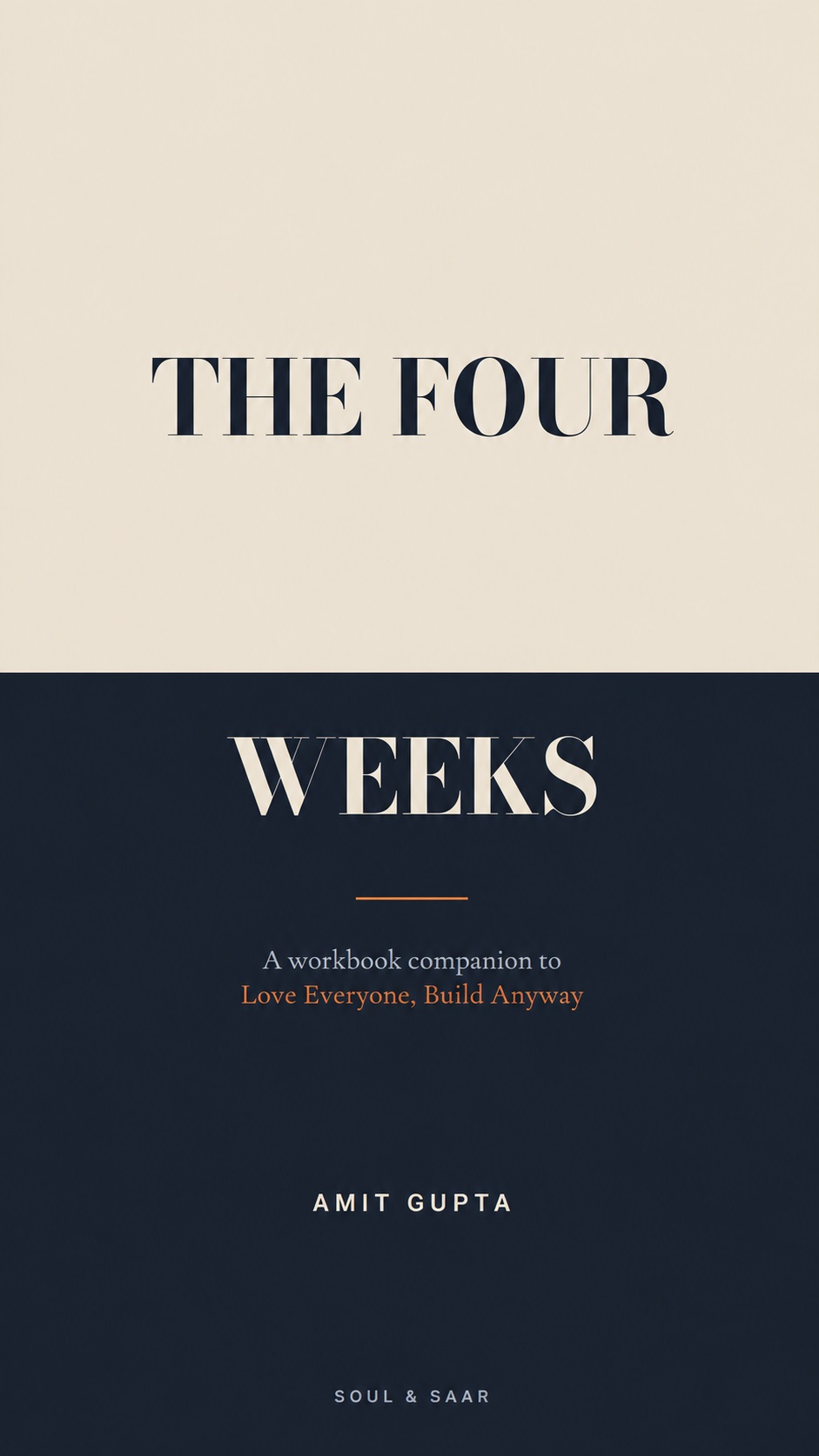
$97 · four weeks
The book is the easy part. Doing the work is not.
Reading about this does very little. The exercises are the part that changes anything, and almost nobody does them alone.
This is not a course. Nobody is going to teach you anything. It is four weeks of questions, in an order that works, with room to answer them by hand.
Week one is diagnostic. Week two is work and money, and it is the uncomfortable one. Week three is the people in your life. Week four is building something you can keep.
$97
39-page PDF, print it or write on screen
Time
About twenty minutes a dayGroup
Fifteen people maximumCall
Thirty minutes, end of week twoMembers
$82 with The LettersTwo rules
“Nobody reads this but you. That is the entire condition under which it works. The moment you are writing for an audience — even an imagined one — you will produce a performance, and a performance is not information about your life.”
Before you start
Inside
Four weeks, day by day
Five exercises a week. Short enough to fit a working day, uncomfortable enough to be worth doing.
Week One
What You Are Holding
Diagnostic. We are not fixing anything yet — we are finding out where your grip is.
Day 1. The Two Columns — what you control, and what you have been worrying about instead
Day 2. The Rehearsal Audit — count the conversations you rehearse that never happen
Day 3. The Four in the Morning Question — follow the fear down to what is actually underneath it
Day 4. What You Have Survived
Day 5. The Load-Bearing Beliefs
Week Two
Work and Money
The commercial week, and the most uncomfortable one.
Day 1. The Service Statement — name the actual human being at the end of your work
Day 2. Extraction or Contribution — audit your five main income sources
Day 3. The Circulation Audit — is it a reserve, or is it a fear?
Day 4. The Good Year
Day 5. Five People — who can you help who cannot help you back
Week Three
The People
The hardest week. Where most of the real cost of a working life shows up.
Day 1. The Frustration Map — who received it, and did they cause it
Day 2. The People You Owe Nothing
Day 3. The Defended Decision
Day 4. One Relationship, Full Attention
Day 5. The Amends
Week Four
What You Build On
Construction. Everything before this was diagnosis.
Day 1. Design the Seven Minutes
Days 2–7. Run It — with a tracker
Day 5. The Failure Ledger
Day 6. The Obituary
Day 7. The Two Sentences
How it is made
Designed to be written in.
Every question has ruled space underneath it. Print it, or open it on a tablet and write straight onto the page.
There is a reason for the handwriting. Typed answers come out tidier than they should. Something about writing by hand makes it harder to produce the answer you think you are supposed to give.
Week dividers, a seven-day practice tracker, and enough white space that it does not feel like homework.
What you get
Four things, $97
The workbook is not sold on its own.
01
The book — 138 pages, PDF and ePub02
The workbook — 39 pages, twenty exercises03
A private group for the cohort04
Thirty minutes one to oneAfter the four weeks
Most people want an hour.
The thirty minutes in week two is short by design — enough to unstick one thing, not enough to work through everything the exercises raised.
A full session is sixty minutes on whatever came up, with a written follow-up afterwards. Plenty of people book one in week five.
Or the written version
The Reading
Sixty-six pages by hand on your pattern, your work and the twelve months ahead. Where the workbook asks you questions, this one answers some.
18pp
Your pattern26pp
Your work22pp
The year aheadQuestions
Before you start
Can I buy the workbook on its own?
No. It only works alongside the book, and the group and the call are what get people to finish it. If you only want to read, buy the book at $10.
How much time does it take?
About twenty minutes a day, designed to sit in the background of an ordinary working week.
What if I fall behind?
Then you fall behind. The workbook is yours permanently and the group does not close.
Refunds?
Refundable until the cohort begins. After that the group has formed and the materials are with you.
$97
Nobody reads this but you.
Twenty questions, in an order that works, with enough room to answer them honestly.
Membership · $7 a month
The Letters
One members-only essay a month, one worked example with the details left in, and three questions answered properly in writing.
And 15% off everything else here, permanently — which means one reading pays for two years of membership.
Members pay
15% less
On every reading and every session, for as long as you stay.